Periodic Boundary Conditions
vortrace supports periodic boundary conditions for cosmological simulation
boxes. When enabled, the nearest-neighbor search checks periodic images
of each query point, ensuring correct projections across box boundaries.
Note
Periodic integrals are assumed to lie entirely within a single periodic image of the box. If your ray spans multiple periodic images, you must split it into segments that each fit within one box image.
Usage
import numpy as np
import vortrace as vt

pc = vt.ProjectionCloud(
    pos, rho,
    boundbox=[0, BoxSize, 0, BoxSize, 0, BoxSize],
    periodic=True,
)

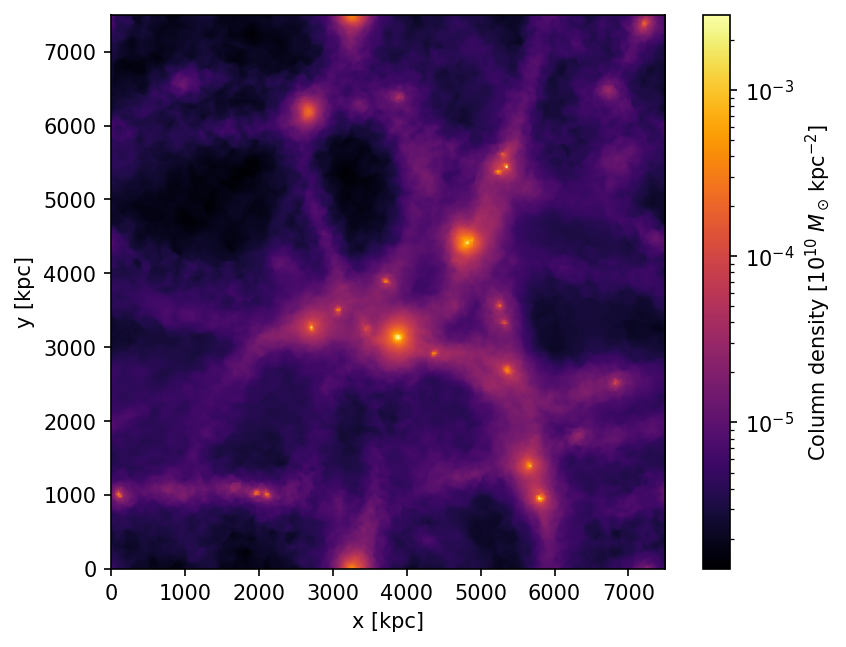
image = pc.grid_projection(
    extent=[0, BoxSize],
    nres=256,
    bounds=[0, BoxSize],
    center=None,
)

fig, ax, im = vt.plot.plot_grid(
    image,
    extent=[0, BoxSize, 0, BoxSize],
    label=r"$\Sigma$",
)
#include <vortrace/vortrace.hpp>

std::array<double, 6> subbox = {0, BoxSize, 0, BoxSize, 0, BoxSize};

PointCloud cloud;
cloud.loadPoints(
    pos, npart, fields, npart, 1, subbox,
    nullptr, 0,   // no cell volumes
    true          // periodic = true
);
cloud.buildTree();

// Projections work as usual -- periodicity is handled internally
Projection proj(starts, ends, ngrid);
proj.makeProjection(cloud, ReductionMode::Sum);
Behavior differences
When periodic=True:
The bounding box defines the periodic domain. The kD-tree wraps queries across boundaries.
No spatial filtering is applied – all particles are used regardless of the bounding box. (In non-periodic mode, particles outside the padded subbox are discarded to reduce computation.) If you need to reduce the number of particles for performance, filter them yourself before passing them to
vortrace.
Note
The bounding box must match the simulation box for periodic mode to produce correct results.